Petrophon Records: A Rare Arab American Record Label Releases Patriotic Songs at World War II's Beginning
Petrophon Records: A Rare Arab American Record Label Releases Patriotic Songs at World War II's Beginning
 |
| Petrophon Record featuring Najeeba Morad on vocals and Petro Trabulsi leading the orchestra in his own composition. Courtesy of Richard M. Breaux collection. https://youtu.be/MDhAPoCpLNg |
Until a few years ago, we had never heard of Petrophon Records, nor had we seen their label. A Grand Rapids, Michigan record collector listed two or three 78 rpm records featuring Najeeba Morad on the popular auction site eBay in 2021. These records were not pressed on the well-known Morad Records later operated by Najeeba and her family, these were both on Petrophon Records.
 |
| Najeeba Morad Karam, 1944. Courtesy of Ad-Deleel. LOC. |
Close examination of these two discs reveals that Petro Trabulsy or Peter Trabulsi and his Arabian Orchestra backed Najeeba Morad on these sides. Petro Trabulsy was the “Petro” from which Petrophon derived. The label also notes that Petro composed the music and directed the recording session on the two discs. This raises the question, who was Petro Trabulsy?
 |
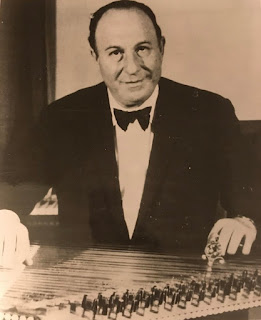
| Only known photograph of Petro Trabulsy. Mirrat Al-Gharb, 28 September 1942. Courtesy of the Moise A. Khayallah Center. NC State Raleigh. |
Petro Sadek Touma Trabulsy was reportedly born to Frieda Khoury and Sadek Trabulsy, immigrants from Homs, in Brooklyn, New York in either 1900 or 1905, depending on the source one uses. According to scholar, author, editor of Trabulsy's poems Hassan Qamhiyeh, Sadek Trabulsy returned with his family to Homs in 1911 and had young Petro schooled in Arabic and other subjects under the tutelage of Youssef Shahin. Petro enrolled at the Internal Orthodox School but because the Ottoman Army took control of the school from 1914 to 1919 and Sadek needed assistance supporting the family. Petro never completed his studies. Around the time, Petro took up goldsmithing and jewelry making, a profession undertaken and mastered since the nineteenth century just over one hundred miles southwest in Damascus.
Immigrants from Greater Syria named Boutos or Petro commonly anglicized their names to Peter when passing through immigration services. Petro used them all at various times although he largely wrote, published, and performed under the name Petro. Conflicting accounts mark Petro Trabulsy's return to the United States in 1924 or 1926. Sources that suggest Petro spent time in the textile business maybe confusing the textile magnet Trabulsi family from Machgharah, Greater Syria (now Lebanon) in the Beqaa Valley, with the Trabulsy family from Homs. We, too, confused these families with one another until we made contact with textile-connected Trabulsi family while researching this entry.
Arab American culture and cultural expression blossomed in the 1920s but government backlash in the form of immigration legislation reduced the number of Arab immigrants entering the United States. Little Syria’s Macksoud Phonograph Company and Maloof Phonograph Company churned out record after record made by Louis Wardiny, Naim Karacand, Wadeeh Bagdady, Andrew Mekanna, Anthony Shaptini, and others. Naoum Morkarzel and Salloum Morkarzel published Al-Hoda newspaper and The Syrian World magazine respectively. Ameen Rihani and Kahlil Gibran shared their literary, political, and social philosophies via their poetry and prose. Largely unappreciated outside of Arab America for their contributions to American culture, anti-immigrant and nativist expression surged. The Ku Klux Klan reached its peak of influence and Congress passed the 1921 Emergency Quota Act, the 1924 Johnson-Reed Act, and Undesirable Aliens Act of 1929. Arab immigration directly from the Near East virtually came to a halt. Arab Americans remained nostalgic for home and simultaneous thrilled with anticipation regarding what their new home might deliver.
Like Ameen Rihani, Kahlil Gibran, Mikhail Naimy, Elia Abu Madi, and others, by the time he was in his twenties, Petro Trabulsy found mentors among writers and musicians. He soon began publishing his poetry in Al-Hoda (The Guidance), Mirrat Al-Gharb (Mirror of the West), As-Sameer (The Entertainer), Al-Sayeh (The Pilgrim), and Al-Bayan (The Explanation). Encouraged by the likes of violinist Naim Karacand and Sami al-Shawwa, during his Sami's to the US between May 1933 and October 1934, Petro's star began to rise.
Newspaper reports documented the musical interests of Petro Trabulsy by the 1930s with much of the activity centered around WBBR, Brooklyn, and Saint George’s Syrian Orthodox Church in Paterson, New Jersey. In February 1930, Trabulsy on violin, Mosa Kalooky on kanun, Fathalla Abyad on oud, and Elizabeth Awad on piano played a short, late-night concert on WBBR New York. Seven months later, on September 17, 1930, Trabulsy joined Nicholas Karshoum in a similar WBBR concert. A mega music concert in August 1933 featured Jamili Matouk, Tony Abdelahad, Wadeeh Bagdady, Mike Hamway, and Petro Trabulsy, among others. In May 1934, a celebration following the christening of Michael Elliot Kabash included entertainment by Naim Karacand, Toufic Barham, Toufic Moubaid, Abe Messadi, Mary Karan, and Peter Trabulsy. One year later, at the same church for the Saint George’s Day celebration, Rose Makhoul Nahmee sang several numbers accompanied by her husband Leon Namhee on piano and Petro Trabulsy on violin. Across the river in on April 28, 1935, Petro and his Orchestra played to a packed house at the Brooklyn Academy of Music. Three years later, in February 1938, the Brooklyn Syrian American Federation hosted a reception and dance headlined by singers Wadeeh Bagdady, and Nazhaat Maliha, and violinist Petro Trabulsy.
 |
| The Morning Call, May 2, 1934. Courtesy of Newspapers.com |
Music was not Trabulsy's only interest, in fact newspapers, like As-Sameer, took lighthearted jabs at Petro for surrendering his heart and attention to Naima Mousalli and marrying her on October 6, 1935. During the course of their marriage, Petro and Naima had Petro, Jr. and Robert. Some sources lists the second child as Johnny.
 |
| The Morning Call, February 4, 1938. Courtesy of Newspapers.com |
Pulling together several of his musician friends and opting for Petro instead of Peter, Petro Trabulsy recorded with Najeeba Morad on his own independent label - Petrophon. He called his group the Arabian Orchestra. Morad sang, at least, two tracks and at least one was World War II-inspired: HS #1128 “Long-Live Uncle Sam” and HS #1125 “Oh, oppressor. I’ve Suffered Enough because of you.”
 |
| Petrophon Record featuring Najeeba Morad on vocals and Petro Trabulsi leading the orchestra in his own composition. Courtesy of Richard M. Breaux collection. |
Two additions to the Trabulsy household brought precious and joyous moments to the young couple with seemingly so much promise for the future. By 1937, however Petro fell ill enough to be hospitalized for a few weeks. Shaken to their core, this scare challenged Naima and Petro to consider the likelihood of not growing old together. Twenty musicians gather in January 1937 to raise funds for Trabulsy's healthcare expenses including Wadeeh Bagdady, Najeeba Morad, Toufic Moubaid, Moses Cohen, Philip Solomon, Russell Bunai, Anton Abdelahad, and Mohamed Zaineldeen. Within a year's time Petro had recovered, and resumed his routine of concerts, poetry submissions to Arab American publications, and generating enough income to provide for Naima (who was raising their two small children). There was not too much time to think about the Japanese bombing of Pearl Harbor, new immigration restrictions, or a nation at war, when Petro's sickness resurfaced. Hospitalized once more for weeks, Petro never recovered. He died 18 September 1942.
Newspapers that once covered Petro career and printed his poetry and short stories, now mourned his loss. The Arab American music community expressed devastation. The funeral at Saint Nicholas Orthodox Cathedral in Brooklyn overflowed with mourners and Naima chose to bury Petro with his violin. Jamili Matouk's singing accompanied by Naim Karacand's violin left no dry eyes in the sanctuary. In attendance, Trabulsy's widow, young children, and a who's who in Arab American recorded and radio music at the time.
Friends and colleagues left with thoughts of a life once filled with promise and hope seemingly cut down before his prime. As-Sameer and Al-Sayeh continued to print some of Petro Trabulsy's poetry up to a year after his death. In 1943, Alamphon Records, owned by Fred Alam, ran advertisements announcing that one of its stars, Jamili Matouk, had recorded songs composed and written by the late Petro Trabulsy. Today, few if any record collectors, music lovers, or students of Arab American history have ever heard of the Petrophon label, yet had it not been for purchasing the 78 rpm records featured above, we may have not heard of Petro Trabulsy, his poetry, or his music at all.
Special Thanks to the Moise A. Khayrallah Center for Lebanese Diaspora Studies at North Carolina State University, Dr. Hassan A. Qamhiyeh, The Life and Poetry of Diaspora Poet Petro Trabulsi (2021), Dr. Sidney Goldman, The United States Library of Congress.
©Midwest Mahjar



Comments
Post a Comment