Posts

Rev. Ilyas T. Kurban: The Recording Legacy of a Tirelessly Working Musical Metropolitan

Image
  Rev. Ilyas T. Kurban: The Recording Legacy of a Tirelessly Working Musical Metropolitan Ilyas T. Kurban from the Caravan, March 21, 1957. Courtesy of Newspapers.com On a mild fifty-degree day in Brooklyn, New York, in December 1956, the Archdeacon Ilyas T. Kurban (Elias T. Korban) made his way to the nearest United States Post Office and mailed a handwritten addressed box to Mr. Lee Beshar Cohlmia at 1932 University Avenue in Wichita, Kansas. The parcel, marked FRAGILE BROADCAST RECORDS, contained four shellac 78 rpm phonograph discs recorded and produced by Sidney Feldman’s Mastertone Recording Studios label in their production facilities at 709 Eighth Avenue, Suite 36, in New York City. The discs contained liturgical and religious singing by Ilyas Kurban. Mastertone likely produced vanity recordings for interested parties who paid for studio time. Vanity pressing arrangements did not bind performers to long-term contracts with record companies. Those with enough money paid fo...

From Background to Foreground in Boston's Arabic Music Scene: Ramza Abdelahad, Yvonne Maalouf Rahwan, and Matilda Dada Stephens

Image
  From Background to Foreground in Boston's Arabic Music Scene: Ramza Abdelahad, Yvonne Maalouf Rahwan, and Matilda Dada Stephens Ramza Abdelahad, Yvonne Maalouf Rahwan, and Matilda Dada Stephens are credited as the chorus/background singers on on Anton Abdelahad's   Middle East Fantasy   LP.  Courtesy of Richard Breaux collection. Often, through no fault of their own, women who clearly have contributed to and made history of their own are excluded from conversations about music making and larger historical narratives. This is a case where literally the identities of the women in a picture only appear in the original source, but vanished from every single secondary source that has reproduced the photograph. In almost all references we’ve seen about Boston-born, Arab American musician Anton “Tony” Abdelahad , we inevitably come across a photograph taken, at some time in the late 1950s or early 1960s, of ten people (seven men, three women) posing inside a recording stu...

Laurice Peters: From the Derbecki Ensemble to the Queen of Cleveland's Arab American Music Scene

Image
  Laurice Peters: From the Derbecki Ensemble to the Queen of Cleveland's Arab American Music Scene Laurice Peters circa 1960. From The Derbecki Ensemble's Hafli: Echos of the Middle East (1960) In the recorded Arab American music scene in the Midwest, Detroit remained unmatched since Albert Rashid first established Al-Chark Records there before relocating his record operation to Manhattan and then Brooklyn, New York. We knew very little about Cleveland’s Arab American music culture until November, 2018, when we found several 33 1/3 LPs in the estate collection of Lucille Joseph Harris here in La Crosse, Wisconsin. Lucille, or Lucy, as she was better known was one of nine the children born to Shikralla Joseph and Mary Skaff Joseph in 1922. The Josephs had a history of initially working as peddlers and then they opened and operate a small grocery store not far from the family residence at 821 Windsor Street. One of the reasons Lucy’s estate contained so few Arabic records may b...

Mohammed El-Akkad: King of the Kanun

Image
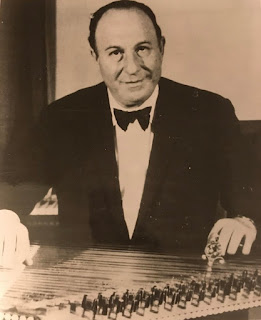
  Mohammed El-Akkad:  King of the Kanun Press photo of Mohammed El-Akkad from May 9, 1985 performance at Northeastern University. Courtesy of Richard M. Breaux collection. Without question Nadha musicians influenced the first generation of Arab American musicians to record in the United States, but few early or middle period musicians can claim to be a direct descendent of a Nadha musician. Mohammed Yousri Moustafa El-Akkad became one of few mahjari musicians who could lay claim this lineage. His grandfather was the Egyptian kanun player Mohamed Eff. Al-Aqqad (1850-1931) and he was born November 27, 1911 in Egypt. The music of the elder Al-Aqqad had been captured on Baidaphon recordings and he taught his grandson to play the kanun. The elder Al-Aqqad played alongside Yusef al-Manyalawi, Abdul Hay Hilmy, Salama Higazi, and other well-known musicians. According to Raphael Cormak, Sami al-Shawa, Mohammed al-Qasabji, and the elder Mohammed el-Aqqad were part of a group that backe...