Abdulmunim Shakir: A Pan-Arab Political Activist and Educator Declares “I Am a Muslim” on a rare 78 RPM Record
Abdulmunim Shakir: A Pan-Arab Political Activist and Educator Declares “I Am a Muslim” on a rare 78 RPM Record
 |
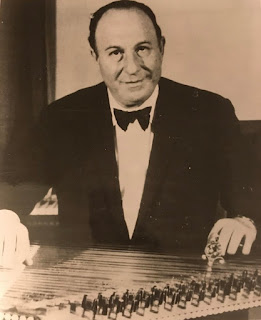
| Abdulmunim Shakir c. 1958. Courtesy iof Richard M. Breaux Collection. |
Few 78 rpm records have intrigued us as much as Dr. Abdulmunim Shakir’s “I Am a Muslim,” backed by “Related Passages from the Holy Quran." Released on a custom label in 1956, it reads for “Exclusive Domestic and Foreign Distribution of Record Through Copyright holder.” Most singers and musicians we’ve written about at Midwest Mahjar traced their ancestry to the so-called Levant but a few like Hana Rached and Mohammed el-Akkad trace their roots to North and northeast Africa.
Abdulmunim Ahmed Shakir or Abdelmoneum Shaker was born to Ahmed Shakir and Nema Shadi on 19 May 1914 (some documents say 1924) in Atbara, Sudan, at the time under Anglo-Egyptian Condominium rule. Ahmed Shakir reportedly served as a brigadier general in the Egyptian military under King Fuad I. In reality, however, Great Britain made and oversaw all major political decisions. This reduced Egypt’s role to one that was largely administrative. Britain even had a standing army in the Suez Canal zone to maintain and protect its own interest under the guise of international neutrality. Abdulmunim attended elementary and intermediate schools that emphasized preparing students for administrative clerkships. English and Arabic functioned as the primary languages of instruction. When not in school, Abdulmunim labored as a floor sweeper, busboy, and then later as a longshoreman. In his twenties, he became a British Merchant Naval officer.
Muslims have been in the United States from its very beginning. Estimates are that from 1 in four to 30% of enslaved Africans practiced Islam. The scholarship of Richard Brent Turner, Edward W. Curtis III, Zaheer Ali, and Michael A. Gomez, has documented the stories of Bilali Mohamet, Yarrow Mahmout, Omar Ibn Said, and other notable Muslims in the history of the early United States. Little Syria's Rector Street masjid, in the early twentieth century, offered a temporary religious space for the faithful in 1900s Manhattan. In Brooklyn, as early as 1907, Muslim Tartars from the Pale of Settlement, where the Imperial Russian Pogroms were previously carried out against Jews and Muslims, created the American Mohammedan Society. From the 1910s through the 1930s, Timothy Drew's Moorish Science Temple, the Ahmadiyya Mission, and even the Nation of Islam added their own ethnically and racially infused interpretations of Islam to Muslims around the country and especially in New York. Immigrants from the Caribbean also founded the Islamic Mission of America in Brooklyn in 1939. All had firmly planted themselves in the United States by 1940.
By the time the United States entered World War II, immigration from the Near East and North Africa had long been reduced to 100 entrants per year as a result of the Johnson-Reed Act of 1924. Approximately, 16000 Arab Americans served for the United States military, and beginning construction on the Brooklyn-Battery tunnel displaced residents of lower Manhattan’s Little Syria. According to immigration documents, Abdulmunim first entered the United States via New York City and by way of Capetown, South Africa, in June 1942. He left, only to return to New York City on 10 November 1942, then departed home to Egypt and returned once more aboard the S.S. Nil from Port Said to Manhattan on 24 March 1943. During the second World War, Columbia University operated a military training center, it became home to the Navy’s V-12 Program, a Midshipman’s School, and contributed significantly to engineering, medical, and general science efforts bolstering the military readiness of the United States and Allied Forces. Some 25000 officers ultimately trained at Columbia and as a chemical engineer Abdulmunim enrolled in Columbia’s undergraduate program and graduated. During Shakir's years at Columbia he provide Arabic and Islamic instruction at what some believe was the Daoud Masjid of the Islamic Mission of America in Brooklyn. Within a year of his Columbia graduation, Abdulmunim enrolled in the chemical engineering program at New York University, and eventually completed a master’s degree in International Relations from City College of New York.
 |
| Abdulmunim Ahmed Shakir's World War II draft card with the same spelling found on the 78 rpm record. Courtesy of Ancestry.com |
One of Abdulmunim Shakir’s earliest documented public speaking engagements addressed the subject of women’s rights and advancement in the Arab world. The North Hudson Business and Professional Women’s Club hosted a dinner where it feted three women employees of the New Jersey Medical Center originally from India, Turkey, and the Near East. Shakir punctuated his lecture with photographs of Arab women from several countries in varied occupational and professional roles. At the time, Shakir claimed to be the secretary of the Arabian Association of Greater New York, but we could find no additional information about the group's existence.
WQXR radio, an experimental AM turned FM mechanical station, then dubbed the station of the New York Times, aired its Youth Forum at 10:15 A.M. On November 28, 1953, it aired a program featuring Abba Eban, US Ambassador to Israel and Abdulmunim Shakir discussing “How Can Unity Be Achieved in the Middle East?” March 8, the following spring, took Shakir to the Social Democratic Front’s Rand School of Social Science where he debated Col. Basil Herman, former Military Governor of Negev and Senior Israel Delegate to the Israel-Egypt Armistice Commission on “Is Peace Possible in the Middle East?” Year’s end brought Shakir to a widely media-covered debate at Sewankaha High School in Nassau County, New York, with Shmuel Gottlieb, a former Israeli Army captain, about the likely failure of Middle East peace talks. Shakir maintained England and the United States “tried to make up for one persecution by creating another, and as a result lost the friendship of 45,000,000 Arabs.” Jews and Arabs had lived in peace for fourteen centuries, he argued, and the Holocaust was a great tragedy, but it’s “immoral, unethical, irreligious, to take the land away from these people.” The relocation of European Jews to Palestine and the removal of Palestinians constituted a “Nakba” - a catastrophic set of events that dispossessed and displaced Palestinian people and destroyed Palestinian society. Shakir emphasized that Arab countries wouldn’t negotiate with Israel unless three basic criteria are met: 1) the internationalization of Jerusalem, 2) acceptance of the 1947 partition borders, destroyed by the Arab-Israeli war in 1948; and 3) the resettlement and restoration of Palestinian lands. Gottlieb responded that Israel’s acceptance of these equaled suicide, that Israel’s payment for the land had been refused, at best Jerusalem’s holy and religious sites could be placed under United Nation’s, and there was no going back to original UN partitioned borders of 1947. One of the only issues the two speakers could agree on was peace talks would likely remain unsuccessful.
The regional speaking tour Shakir booked for himself in 1955 took him to several New York and New Jersey cities; his argument, however, remained the same. The Eid-al-Adha celebration by the Federation of Islamic Associations of the US and Canada’s Muslim Council of New York brought with it an announcement that the fifth annual Federation meeting would take place in Manhattan in 1956. Abdulmonim Shaker served as the Iman, led prayers, and gave a sermon at the event. Months later, in Englewood, New Jersey, at an event sponsored by the Americans for Democratic Action, Shikar repeated the three core demands from previous debates. Arguing on behalf of Israel, this time - Dr. Arich Plotkin, rebutted with a similar argument that Israel would not concede any conditions made by Palestinians and their supporters. While the debate went as planned, several Pro-Israel audience members persisted, questioning Shakir about his earlier arguments including Czechoslovakia’s 1955 arms deal with both Israel and Egypt. As the moderator ended the event, Shakir retired to coffee room only to have opposition audience members berate him for his position well after the event’s close.
Abdulmunim Shakir kept up a tireless schedule of talks, editorializing, debates, in support of Palestinian resettlement, Egyptian self-determination, and Arab anti-colonial struggle. In a January 1956 editorial, Shakir cited the late Mohandas K. Gandhi writing, “There are hundreds of ways to deal with the Arabs, if the Jews only discard the use of the bayonet.” The spring of 1956 began with the dedication and opening of what was hailed as the first all-faith chapel in the United States. Located in Manhattan’s Universalist Church of Divine Paternity the physical building contained symbols and scriptures from Buddhism, Christianity, Confucianism, Hinduism, Islam, Judaism, Shintoism, Taoism, and Zoroastrianism. Official attendants included an United Nations delegation, a Buddhist priest, a rabbi, a Hindu minister, and an imam. Abdulmunim Shakir represented the Islamic faith in the United States.
When the Suez Canal Crisis arose in the summer of 1956, Abdulmunim Shakir, who appeared to be an Arab nationalist also, squarely aligned himself with Egyptian President Gamal Abdel Nasser. Nationalizing the once British-French-financed Suez Canal (built in 1869) stood out as an act of self-determination and anti-colonialism. It would also help to fund the Aswan Dam project, with or without British and US support. Determined to depose Nasser and invade Egypt, British, French, and Israeli representatives met secretly at Sevres and planned an invasion of the Sinai Peninsula and the Canal Zone with France and Britain posing as peacekeepers. As British and French forces attacked Egypt, Nasser ordered the sabotaging of the Suez Canal and many of the ships in it. This halted total traffic through the Canal. Shakir’s editorial protesting this invasion and blaming the tripartite forces for murdering innocent Egyptians appeared in the New York Times on 5 November 1956. Angered by the secret tripartite meeting between Britain, France, and Israel, and concerned this planned takeover would draw Egypt and other Arab states toward communism and the Soviet Union, US President Dwight Eisenhower used diplomatic and economic pressure to force a British ceasefire and withdrawal from Egypt. Abdulmunim Shakir wrote related editorials in the US press, offering a unique perspective of these events and cementing his reputation as an expert of Middle East politics and culture. He also made a guest appearance on WGBH Boston Television’s Louis Lyons and The News to discuss “Middle East Crisis: An Arab View” on 30 November 1956. Again, Shakir had his critics and opponents. Some opponents claimed that Egypt and Jordan, not Israel, had been an ongoing aggressor infected by “Nasserism.” Others argued that Egypt violated the armistice agreement and led a six year campaign against Israel.
 |
| Madga Neeld (l) and Yanesse Donfray(r) assisted Shakir on his record. Donfray played violin. Courtesy of Richard M. Breaux collection. |
A collaborative project involving singers Virginia Flint, Magda Neeld (1908-2007), Dorothy Bell, arranger Jacques Press (1903-1985), violinist Vanesse Donfray (1909-1982), and Abdulmunim Shakir led to the release of the 78 rpm record “I am a Muslim” in 1956. This song alternates between a prayer and a poem/song written by Abdulmunim and sung by Dorothy Bell backed by Donafray’s violin accompaniment. The flip side of the record contains Quranic recitation by verse and direct English translation all by Shakir. As we’ve noted in other posts, Shakir was not the first Arabic-speaking Muslim immigrant to the United States to record the basmala on 78 rpm. Mohammed ZainEldeen recorded on Columbia as early as 1917 and Assad Dakroub made a similar recording on A.J. Macksoud’s label in the 1920s. The English translation and audio profession of faith in English and Arabic are what make this recording standout and appear more intended for education than entertainment. This concept remains consistent with Shakir’s beliefs and role as an educator.
 |
| Bell & Shakir, "I Am a Muslim," https://youtu.be/eavCWtI5xXs |
 |
| Shakir, "Related Passages from the Holy Quran," https://youtu.be/SjkDqs7JvhM |
Concern about conflict in the Middle East and North Africa continued in the United States as New York City’s All Souls Universalist Unitarian Church sponsored and hosted a series of discussions in 1958 first with Abdulmunim Shakir, representing the Arab States Delegation to the United Nations, for the first event, followed by Uri Ra’Anan, Israeli Counsel in New York, in a subsequent discussion. US Coast Guard Commander Albert A. Lawrence moderated both conversations and both speakers presented a set of problems and proposed solutions for audiences to consider. Approximately, 100 people attended both events, although the latter had to be rescheduled for inclement weather. As some viewed developments, the greater issue was communist interference in the region.
A pan-Arab influenced consolidation between Egypt and Syria led to the short-lived existence of the United Arab Republic in early 1958. Yemen joined Egypt and Syria in a fairly short time to comprise the UAR. Meanwhile, at nearly the exact same time, cousins Jordan’s King Hussein and Iraq’s King Faisil II formed the “Hashemite Federation” more aligned with British and America rather than pan-Arab and communist interests. Much to the surprise of Western spectators, 14 July 1958 witnessed a revolution in Iraq resulting in the assassination of King Faisal II, the Crown Prince, and the Iraqi Prime Minister by Iraqi military forces. To shore up their interests, Britain deployed troops to Jordan and the United States sent troops to Lebanon in alignment with the Eisenhower Doctrine. In response, Abdulmunim Shakir scolded the Brits and Americans about their support of Western loyalists regimes above all else no matter how popular or corrupt sitting governments in Jordan or Lebanon were at the time. Shakir labelled such tactics doomed and opined, “Pressure, overt or covert, is often used by the West to obtain either lucrative economic benefits like oil contracts, or war bases and military pacts, which aim to keep the Arab world in the so-called Western sphere of influence.”
 |
| Ad for speaking event. The Day March 14, 1958. Courtesy of Newspapers.com |
The interests of college, church, and civic groups in receiving accurate first-hand information kept Shakir’s schedule full. The topics, although similar, captured national, regional, and ethnic nuance: He discussed the Crisis toward Cypriot independence at Saint Peters College in October 1958; he explored the need for Muslim, Christian, and Jewish solidarities towards peace at New York City’s Church of the Covenant in December 1959; he explained connections between nationalism, self-determination, and oil with Rotarians in a Philadelphia suburb in March 1960; and by 1962 the struggles between competing sides in Yemen became a sought-after topic of discussion. Shakir only stopped seemingly for personal business of the utmost importance.
We don’t know for certain what circumstances encouraged Abdulmunim Shakir to seek or pursue naturalized citizenship but on 20 December 1965 in the US District Court in New York, he swore an oath and became an official United States citizen. Perhaps the coming completion of his doctoral program signaled a need to broaden his occupational options. But Congress’s passage of the 1965 Immigration and Nationality Act at this moment cannot be understated.
 |
| Record of Abdulmunim A. Shakir's US Naturalization. Courtesy of Ancestry.com |
Shakir sought a doctorate degree at New York University while continuing on the lecture/debate circuit; he eventually settled into a college teaching position in Maine. He supported himself by working as an instructor at NYU and Brooklyn Polytechnical Institute. Shakir completed “Individual and Social Responsibility in Islamic Thought” in 1966 as his doctoral dissertation. Dr. Charles Worth Howard, a former librarian, dean, and president at the American University in Cairo, and, at the time President of Ricker College, in Houlton, Maine, alerted Shakir to an opportunity in Muslim World Studies at Ricker. Muslim World Studies included history of Islamic societies, institutions, government, and the Arabic language. It prepared its students to work as scholars or researchers in the field, as business people overseas, and as foreign service workers for the United States government.
One of Abdulmunim Shakir’s crowning achievements during his tenure at Ricker College came when he secured a $50,000 grant from King Faisal of Saudi Arabia for the Muslim World Studies Program in 1968. According to Shakir, Faisal saw it as one of several opportunities to build a bridge between the United States and the Muslim world. Shakir also used the media coverage to dispel stereotypes about hijabi women, harems, and differences in the experiences of rural versus urban women in Muslim majority countries. Overall, the gift served as an impetus for raising more funds for Ricker’s Muslim World Studies Program via speaking engagements. An additional $10,000 came from the American Arabian Oil Company and the Government of Kuwait gifted another $8000. The first two graduates of the program went on to pursue higher degrees at the American University in Cairo.
 |
| Dr. Shakir accepts a gift of $50,000 for his Muslim World Studies Program from Saudi King Faisal, 1968.Courtesy of Richard M. Breaux collection. |
At Ricker College, Shakir served as an executive of the International Relations Council, took part in panels on the impact of the Vietnam War, organized the college’s international education, food festival, and continued to educate students and the local community about Middle Eastern culture and politics. A point of personal pride came when Jewish students at Ricker College selected him as their student group advisor. The African American student organization on campus also secured Shakir as their faculty advisor. Shakir even organized a lecture series that helped usher in African American Studies on campus. This served as a symbol of his call for people across race and faith communities to work towards larger goals of peace and equality. Despite reports of record enrollments at Ricker in 1968 and 1969, by 1975 the College’s finances reached a disastrous point. Ricker College shuttered in 1978. Shakir, after loss of tenure and job, packed up and moved to the Detroit metropolitan area - then and now - home to significantly large Arab American and Muslim American communities.
While some sources suggest Dr. Shakir found employment at Wayne State University, that we can tell, he found work teaching Arabic and Islamic Studies at Wayne County Community College. One of the people Shakir knew best in Dearborn included Aliya Ogdie Hassen, the Muslim, feminist, who acknowledged Shakir's assistance in her manuscript "Religious Stories for Young Muslims." Students who took courses with Dr. Shakir in the 1990s remembered him as a tough professor in class, but a person with a deep love and respect for Arab and black people outside of class. In the last decade of his life, Dr. Shakir settled into his place as a professor, advisor, scholar, and community educator in Dearborn, Michigan. Some will recall the Muslim presence in the area going back to 1921 when Muslim immigrants constructed one of the nation’s oldest purposeably-built masjid in the United States in Highland Park, Michigan. More Muslim immigrants arrived in the United States and Dearborn after World War II, some as refugees from Palestine in the late 1940s through 1960s, and many following the passage of the 1965 Immigration and Nationality Act passed. The Islamic Center of America in Detroit reportedly began with fifty families in 1961 but between 1973 and 1993, noted their numbers blossomed into the thousands.
Abdulmunim Shakir worked as President of the Board of the Islamic Cultural Center at Lake Shores. On occasion, he crossed paths and attended events alongside former Nation of Islam leader Warith D. Mohammed (also known as Wallace D. Muhammad). Of course, Shakir continued to educate larger miseducated communities about Islam is where he could be found. In November 2000, there were his words in the Detroit Free Press warning citizens of the duplicitous dealings of the United States in the Middle East. Listed as a member of the Committee for Fairness and Justice in American Middle East Policy, Shakir seemed to hold out hope that America’s citizens and electorate could propel that nation doing right by Muslim majority countries.
 |
| Abdulmunim Shakir. 1990s. Courtesy of Richard M. Breaux collection. |
On a more personal note, during the course of researching Abdulmunim Shakir we came across several photos of him on panels, at speaking engagements, meeting various people, and both in and out of doors. No matter the occasion, he always seems to have worn sunglasses in public. Whether this was related to a medical condition or a matter of personal choice remains unknown.
Abdulmunim Shakir died on 2 February 2006 in Dearborn, Michigan. In his obituary, ten years had been shaved off his age making his birth year 1924, instead of 1914. Nearly twenty years after his passing, he is remembered warmly by his former students, and today, the Islamic Society of North America awards an academic scholarship for high school seniors entering college as first-year students the next year.
Richard M. Breaux
© Midwest Mahjar



Dr.Shakir was my friend. Rest in peace
ReplyDelete