The Music of John Fayad: La Voz del Desierto
The Music of John Fayad: La Voz del Desierto
 |
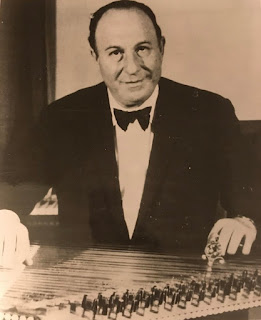
| Photo of John Fayad. circa 1975. Courtesy of Richard M. Breaux collection. |
Before writing this profile, I could find very little information about John Fayad in one place. I first came across his name in 2019 when I purchased two 78 rpm records on the Voz del Desierto label. Searches online and in Discogs yielded albums on the Piramade label also named Voz del Desierto. No 78s on the label emerged in my results signaling the rarity of the two 78 rpm discs likely recorded and pressed at the height of Fayad’s career in the 1950s. Fayad’s oud playing is stellar. Remarkably as good as any of his contemporaries in the United States or Latin America. But available government records suggest Fayad remained a roaming musician for most of his life. For short periods he resided in Havana, Miami, Belize City, and Mexico City, but he was never in any of these places long enough to leave anything but a smattering of documents. He should also not be confused with the 1940s Detroit, Michigan, singer John Fayad, whose photos confirm he was not the same person featured here. Our primary document research and thirty-minute conversation with a niece that saw him so few times she could count his visits on both hands reveals the following.
John Fayad was born forty-five miles north of Beirut in Bdebba, Greater Syria (now Lebanon) in 1917 or 1918 [some sources guess 1921] to Philip and Mariam ElJure Khoury Fayad. He was one of six children in a family with three boys and three girls. Raised in the Greek Orthodox Church, at some point in his young adulthood, John attended the Institute of Music in Beirut, which soon became the Conservatoire Libanais. In the early 1940s, John’s brother, Jacob Fayad, left French-mandated Lebanon for Belize, British Honduras (now Belize City, Belize) and met and married the locally-born Nora Idolly Courtenay in 1942. John left an independent Lebanon a few years later.
As Jacob and Nora started their family, John Fayad set sail from Beirut to South Hampton, England, to New York to Belize City. When John Fayad arrived in New York City in April 1947, his plans included a fifteen-day layover. Places John Fayad visited have been lost to history. He eventually continued on to Belize but he was back in the United States in a year’s time after he attempted to operate a restaurant with financial support from his brother. In April 1948, one of Fayad’s first US gigs received attention in the Florida Times Union. The Jacksonville Lebanese Ladies Charity Society held a fundraiser featuring John Fayad on oud on Friday, April 15. Did Fayad leave the United States and return a year later or tour in cities with Arab Americans and Arab immigrants? We’re not sure but it seems he married Helen J. Aboyoun on 22 December 1948 and he remained in Miami, Florida for a year or two. In May 1949, Fayad played for the women of Miami’s Phoenician Club. Fayad supplied the music and a young man named Jimmie Israel, Jr. performed a non-regionally specified Arabian dance. Sources suggest Fayad had only remained in Miami and hosted and sang on a radio program for a year or two before he divorced Helen in 1950, secured a similar gig in Havana, Cuba, for the same amount of time - then he toured Jamaica.

 |
| John Fayad 1-A "Ya Schark" and 2-B "Al Kamar" on Voz Del Desierto 78 rpm. Courtesy of Richard M. Breaux collection. John Fayad 1-A "Ya Schark" https://youtu.be/w6W3xsL22bk John Fayad 2B "Al Kamar" https://youtu.be/DhqkAa9DXFc |
John Fayad played a series of private and public concerts in several Kingston, Jamaica locations. The first took place 2 August 1952 at the home of a Mr. Kalphat at 87 Hope Road. Fayad sang in both Spanish and Arabic. Next a Kingston recital sponsored by Pan American Airways made up of a film with music accompaniment by John Fayad and dancing by Shirley Seaga occurred on 13 August 1952. Perhaps his most important engagement in Jamaica was the Saint George’s College Spanish Department event in conjunction with the Consular Corps that had political representatives and performers from Costa Rica, Venezuela, Nicaragua, and Spain in attendance. Fayad performed Andalusian music on his oud and there were also piano, dance, and choral performances including the Venezuelan National Dance Company. This event helped Fayad network with artists from several Latin American countries and laid the groundwork for concert tours and recitals later in his career. In December, Kingston’s International Club hosted its “Memories of Arabia” night. This celebration brought out a who’s who of Arab Jamaicans for food, dance, speeches, music, seminars, and dramatic sketches. Newspapers reported on the popularity of the debke led by Shirley Seaga, Toufic Azan, Joyce Nazrallah, Carmen Azan, and Ronnie Nasrallah. One source noted that John Fayad would soon be traveling to Santo Domingo, Dominican Republic and Caracas, Venezuela for his next concerts.

 |
| John Fayad "Layaly" and "Maual" on Voz Del Desierto 78 rpm. Courtesy of Richard M. Breaux collection. John Fayad "Layaly" 5A - https://youtu.be/nPA4YZX_AIg John Fayad "Maual" 5B - https://youtu.be/Wcj7eSPoqTg |
The year 1956 brought John Fayad back to the United States and to Miami. The January marriage of Laurice Azrak and Shakib Joseph brought John Fayad, Antoine Hage, Little Sami, and George Kababby together as entertainment for a lively wedding reception in Miami, Florida. Sources suggest Fayad resided more permanently in Mexico at the time. The same group who played the wedding reception collaborated for a January 22 hafla also in Miami. Syrian and Lebanese residents of West Palm Beach had Mosa Kalooky, John Fayad, Antoine Hage, Louis Haddad, Mike Shashaty, and Fred Rahal as the main act at its hafla on February 25. Proceeds went towards the building of a Syrian/Lebanese American Clubhouse in West Palm Beach. Joe Budway, Eddie Kochack, Emil Kasses, Antoine Hage, Al Fahmie, and John Fayad headlined at the Syrian Lebanon American Club of Miami’s three-hour “Dream Boat” cruise at Pier 10. March and April meant a series of booked parties and celebrations in south Florida on March 26, April 7-8, April 15, and April 27 before John Fayad’s reported return to Mexico. The grandest of these events, however, was the March 15-18 Arabian Nights Pageant in Opa-Locka. It featured jazz musicians Cab Calloway, Lynn Hope, Boyd Bennett and his Rockets, John Fayad, and Emil Kasses. Rumor has it that several Arab families founded the city of Opa-locka, Florida, but this seems to be more fiction that fact, rooted in the architectural design of Opa-locka's city hall.
 |
| Report from the 29 March 1956 Caravan newspaper mentions John Fayad, Eddie Kochack, Joe Budway, Antoine Hage, and Emil Kasses. Courtesy of Newspapers.com |
Much of the remainder of John Fayad’s life received intermittent media coverage. In 1958, he sang and played at the 25th Anniversary of the Syrian Social Nationalist Party in Mexico City, much to the delight of attendees. He released three albums on the mysterious Pyramid or Piramide label under the frequently used moniker Voz Del Desierto. The albums have a Mexican imprint and one album is a three-LP compilation. The albums songs were sometimes in Spanish and/or transliterated Arabic on the label. Musically, each album contains a combination baladi, mawal, and ataba. Songs included "Love of Homeland," "Quiet Love," "My Beautiful Rose," "Leave Me By Your Side," "Night of Love," and "We Are All Brothers." Fayad collaborated with Jose Elido and Juan Freig Celome on several of these songs.
 |
| John Fayad's 3-disc album also called "La Voz Del Desierto." Courtesy of Richard M. Breaux collection John Fayad "El Amor De La Patria" & "Porque Esta Enojada" Vol 1 Side A- https://youtu.be/SGb90oufWko John Fayad "Todos Somos Hermanos" & "Donde Estas Mi Amor" Vol 2 Side A - https://youtu.be/45N1D8fszz8 John Fayad "Ala El Chate" Vol 3 Side A - https://youtu.be/R_LFOJ_coBw John Fayad "Dahaba El Muchib" Vol 3 Side A - https://youtu.be/8i1atXQIR-4 |
Ultimately, John Fayad spent most of his later years in Mexico. He continued to make visits to and from the United States and occasionally visited his older brother Jacob a few times in Belize and later in Regina, Canada.
The last two media reports located about John Fayad are his attendance, in 1979, of 47th Anniversary of the Syrian Social Nationalist Party with a host of Syrian/Lebanese Mexicans and news of his passing in 1980. Although they logged significant activity in Brazil and Argentina, there currently exists very little information written about the Syrian Social Nationalist Party in Mexico City.
 | |
John Fayad (sitting far right) at a 1979 Syrian Social Nationalist dinner in Mexico. Al-Gurbal Revista, 1 Mayo, 1979.
|
John Fayad died on 26 February 1980 in Mexico City. While the person who registered his death seemed to know Fayad’s parent’s name, he did not get Fayad’s birth year or exact birth city correct. Fayad’s occupation is listed as “none” but he died of a heart attack caused by a partially blocked artery. He is buried at Panteon Frances de San Joaquin in Mexico City. In many ways, this was symbolic of John Fayad’s life in the Americas. He was always on the road, travelled from country to country and occasionally checked with friends and family. He seemed, however, most dedicated to his love of singing and playing music. It’s rather fitting, then, that what largely remains of him is the sound of his voice and oud on record.
 |
| Mexican Certificate of Death for John Fayad. Courtesy of Ancestry.com |
Special thank you to Ben and Jeanette for putting up with my questions.
Richard M. Breaux
© Midwest Mahjar



Comments
Post a Comment