Garam Chiba: A True Mahjari Musician
Garam Chiba: A True Mahjari Musician
 |
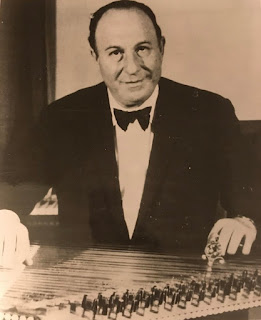
| Garam Chiba, 2 December 1954. Courtesy of El Mundo Arabe. |
I have written previously about how stage names and pseudonyms can cause a biographer enormous headaches when attempting to locate subjects. Musicians of Arab descent who lived portions of their lives in the Levant, Egypt, Brazil, Argentina, the United States and other countries remain particularly difficult to track down and locate. For several years now this was the case with our locating oudist and vocalist Garam Chiba. Ever persistent, I did not throw in the towel and with a deeper dive, I found a bit more than just the three articles - one in Arabic, one in Spanish, and one in Portuguese - I had uncovered previously.
Garam Chiba was born Andre Joubran Chaibe to Maubaraque Khairallah and Joubran Chaibe on 22 October 1919 in the Sour municipality of Tyre, Greater Syria (today Lebanon). Tyre sits 50 miles south of Beirut and emerged as a Lebanese cultural hub where the first movie theater, the Roxy, opened in 1939, when Chiba turned twenty and the Empire Cinema opened in 1942. Both the Lebanese National Conservatory of Music in Beirut and a music conservatory in Cairo operated as training grounds for a young Garam. He mastered the oud and studied composition and voice, gaining proficiency at all three. Radio work in Lebanon, Syria, Palestine, and Egypt during the early 1940s introduced Garam Chiba to Arabic-speaking audiences in these countries. He had an infectious on-air presence and this soon gained Garam popularity and notability. Soon he caught the eye of film directors and was cast in the Egyptian cinema’s “Al-Suq al-Soda” (1945), “Al-Haram,” and “Al-Koll Yughanni” (1947).
 |
| Garam & Rose around 1956. Courtesy of Gaby Shiba. |
In 1951, Garam and his young wife, Rosa Stephan de Chaibe, traveled to Buenos Aires, Argentina, for Garam to further pursue his music career. By this time, Lebanese immigration to Argentina paled in comparison to Arab immigration to Mendoza, Buenos Aires, and San Luis between 1870 and 1920. The Lebanese communities of Argentina welcomed the Chaibes with open arms. Subjects of the collapsing Ottoman Empire represented the fifth largest immigrant group to Argentina behind Italy, France, Spain, and Russia before 1920 and the sixth largest before 1940. Oudist Elie Younes and singer Hanan or Jeanette Harouni both spent time recording in and enjoyed enormous popularity in Argentina. Both of them recorded on RCA-Victor Argentina as did Garam Chiba. Although they felt at home in Argentina, Brazil’s Arabic-speaking communities came calling Garam and Rosa Chaibe.
 |
| Garam Chiba. Courtesy of Richard M. Breaux collection. |
San Paolo, Brazil became home in 1952. The city’s population reached 2.2 million people in 1950 and boasted the largest number of Brazilians of Arab descent. There, Rosa and Garam had their only child Gabran Andre Chaibe. Next the trio moved to Rio de Janeiro for a brief period before settling in Buenos Aires for the next twelve years. Back in Argentina, Garam toiled and performed at restaurants and night clubs. Rosa often accompanied him.
 |
 |
| Garam Chiba, "Riskala" & "Nissite" . 78 rpm images courtesy of Henrique Tabchoury collection. |
That we know Garam recorded on the Gravaçåo Especial [a subsidiary of Continental ] in Brazil and Colonial/Standard Phono Corporation record labels. His 78 rpm singles such as “Churuki I-II” P602-AB and “Al-Kubal” P599-AB on Gravaçåo Especial are more difficult to find today than his Colonial LPs - “Songs and Dances of Lebanon,” “Holidays in Lebanon & Syria,” and “Memories of Lebanon.” The latter is most notable because Chiba collaborated with veteran recording artist Nahem Simon in the 1960s. On most occasions, Garam performed with his group who were known simply as his “Typical Ensemble.” The ensemble included Safuh Charbayi, Garam’s older brother John Chaibe/Jean Chiba on violin, and Selim Wazzani on percussion. On his LP’s Chiba added a kanun and a gyil player. On the US recording, S. Malko replaced Selim Wazzani. The largest collection of Garam Chiba 78 rpm records I know of belongs to record collector Henrique Tabchoury in Sao Paulo, Brazil. Henrique reminds us that Chiba sang on some records but also composed songs recorded by other vocalists.
 |
| Safuh Charbayi. Courtesy of Richard M. Breaux collection. |
 |
Side #1 - https://youtu.be/OplUOcduZsc |
Standard/Colonial Phonograph Corporation was, of course, a company owned and operated by Turkish-born Greek American tenor Tetos Dimitriadis. A 1921 immigrant, former Victor Talking Machine singer, and radio performer who climbed the ranks to become head of Victor’s Foreign division, Dimitriadis began pressing his own records on Standard out of a transformed rubber mill where he also operated a working farm on the land surrounding the mill. Tetos pressed 17 records in 17 languages per month from his Universal Manufacturing Corporation in Franklin Park, New Jersey, near New Brunswick.
 |
| Songs & Dances of Lebanon featuring Garam Chiba and his Orchestra. Courtesy of Richard M. Breaux collection. Side 1 - https://youtu.be/V5U1DcwmBUw Side 2 - https://youtu.be/Gjf5c_YZXOo |
Garam Chiba spent much of the mid to late 1950s and early 1960s traveling back and forth between South America, Egypt, and the United States. Chiba worked the Cairo casino and nightclub scene in Egypt. In November and December 1954, Chiba and his family took the train via the Transandine railway from Buenos Aires to Santiago. Once in Santiago, El Mundo Arabe editor Jorge Saba Zurob arranged to have Chiba perform at the Club Sirio Unido and Club Palestino. Next, the Chiba’s travelled to New York and it’s here the Garam collaborated with Nahem Simon.
 |
| From l to r, Selim Wazzani, Jorge Saba Zurob, Jean Chiba, Safuh Charbayi, and Garam Chiba. 16 August 1962. Courtesy of El Mundo Arabe. |
I learned about Garam Chiba by researching vocalist Nahem Simon. Victor and Columbia recording star, Nahem Simon settled in the United States in 1910 after he emigrated from Broummana, Mount Lebanon, Greater Syria. Simon recorded on Columbia in 1915 and Victor and Columbia by 1916. Arguably, he became the two major labels’ best selling Arab American vocalist in the 1910s and 1920s. He preserved over twenty-three songs for Victor and over nineteen for Columbia. Despite a hiatus from recording, Simon continued playing events in Brooklyn’s Little Syria through the 1940s and he occasionally popped up on Standard label singles and on sides with Abe Massadi on the Arabic Recording Company label through the 1950s. Simon’s projects with Garam Chiba and Toufic Moubaid likely represent his last recorded works.

Side 2 - https://youtu.be/7GvCwCrdCgw
 |
| Nahem Simon. c. 1919 Victor Arabian Records Catalogue Supplement. Courtesy of Amr Noshey. |
After four years in the United States, the Chibas returned to Lebanon. Never one to remain in one place for long, Garam Chiba moved to Canada and then to London, England. He continued to play London’s immigrant club scene for the next twenty years. As he aged and opportunities dried up, Garam retired from playing music professionally. He and Rosa went back to Lebanon during the latter years of the Lebanese Civil War and Rosa died in 1995.
Life in Lebanon improved after the war but Garam grew lonely without Rosa. Their son Gaby had established himself as a dancer with studios in Egypt and Brazil over the years. By the time he reached his nineties, Garam had slowed immensely but performed publicly on occasion. Gaby offered to take care of and see after his father and Garam finally agreed to move to Brazil for good in 2015.
Garam Chiba aka Andre Joubran Chaibe died on a hot, humid, Brazilian summer day on 7 January 2017. Most of the musicians with whom he played were long gone. Chiba’s legacy lived on in his son Gaby Shiba, a world-renown dancer, teacher, and choreographer of Egyptian, Lebanese, flamenco and other folkloric dances. Gaby Shiba, born Gabran Andre Chaibe, died 3 June 2026, as I was putting the finishing touches on this profile.
Special thank you to Henrique Tabchoury, Roxanne Shelaby, & Gaby Shiba.
Richard M. Breaux
© Midwest Mahjar



Comments
Post a Comment