Tanious Maroun Al-Blouzany: A Little-known Poet and Singer records for Maloof Records
Tanious Maroun Al-Blouzany: A Little-known Poet and Singer records for Maloof Records
 |
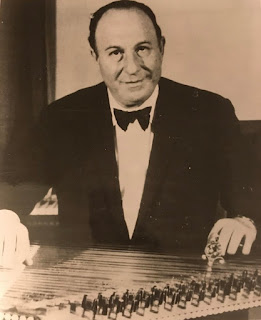
| Tanious Maroun al-Blouzany, 1936. 29 August 1936, Al-Hoda newspaper. Courtesy of the Moise A. Khayallah Center for Lebanese Diaspora Studies, North Carolina State University. |
I asked Excavated Shellac’s Jonathan Ward about both records. Back in 2019, I had written a post about Samy Attaya, but at the time, I had never actually seen or heard one of his records. I have since attached the digitized audio transfer to Midwest Mahjar, but “OUZANY” remained a complete mystery to me.
A few days after receiving the discs, I posted a photo of the label on social media requesting assistance to read it. My plea was met mostly with silence, alongside a few suggestions to try taking a clearer photo. However, Dr. Hanna N. Haydar from CUNY Brooklyn College could decipher enough of the faded gold print to read and translate the side’s title, “Lbesna Drouhna-Ataba,” as well as two-thirds of the singer’s name: “Tanious Maroun ?Ouzany?” or “alnouzany?” or “allouzany?”
For over three years, I searched Dr. Nagib Abdou’s and Al-Hoda's directories from 1907, 1908, and 1910, as well as the 1930 New York City Syrian Directory, going down countless rabbit holes looking for surnames with "OUZANY." I misidentified one or two individuals along the way, but eventually, I finally deciphered the full name: Tanious Maroun al-Blouzany.
Online searches, the Discography of American Historical Recordings database, and Dick Spottswood’s Ethnic Music on Records yielded no leads, hints, or suggestions. Then, in a May 1926 advertisement for Maloof Phonograph Records, I confirmed that “al-Blouzany” had indeed recorded for the label.
I was still no closer to finding his city or state of residence, but I subsequently located a photograph of al-Blouzany in a 1936 issue of Al-Hoda. His image appeared on a page alongside other prominent artists of the era, including Joe Budway and Fathalla Abyad. Although al-Blouzany frequently traveled to Brooklyn, a few stories in Al-Hoda noted his connection to North Adams, Massachusetts. Off to local newspapers I went to explore further.
Despite his being mentioned in about a dozen stories in Al-Hoda, I could not find a single person in North Adams with the surname al-Blouzany. How was it possible that someone who figured so prominently in several Arabic-language newspaper stories never appeared—not even via a mere mention—in the local North Adams press? Surnames like Ziter, Ferris, Shakar, and Ellis appeared regularly, but not al-Blouzany.
Soon, I noticed the name "Tony Morin" mentioned in several local articles as a performer at Syrian events, and the realization struck me: say both names aloud—"Tanious Maroun al-Blouzany" and "Tony Morin." What if, like Maloof star Salim Doumani (where "al-Doumani" signified being from Douma), "al-Blouzany" simply meant someone from Blouza (or Blaouza), Lebanon?
Tanious Maroun al-Blouzany, known locally as Tony Morin, was born on July 17, 1898, in North Adams, Massachusetts, to immigrants Anna Nicholas and Khalil “Carl” Morin from Blouza, Greater Syria (present-day Lebanon). Khalil operated a fruit stand, worked on the railroad, and collected scrap metal, while he and Anna sent their children to local public schools.
By 1914, Tony was already in trouble with the law for stealing copper wire and other items from the Arnold Print Works. Likely owing to his young age, Tony was arrested, arraigned, convicted, and sentenced to a $10 fine, walking free within two hours. It was his first publicly documented encounter with the law, but it would hardly be his last.
Just over two months later, Tony was arrested, found guilty, and fined $5 for peddling without a license after setting up a fruit stand on Summer Street to help bring income into the household.
The next time his name made the news was in September 1916. Tony and several members of the Morin and Ziter families were involved in a massive street brawl with members of the Deep family in North Adams. Police arrested thirteen people. Louis, Joseph, and Tony Morin were all stabbed or wounded with a knife, with both sides claiming the other was at fault. Nine of those involved were released on $500 bail, while the remaining brawlers were held on $200 bail.
Things appeared to be on the upswing in 1918 when Tony began an amateur wrestling career and married Maskina Stevens, an immigrant from Syria four years his junior. Maskina had immigrated to the United States in 1909 and settled in North Adams with her mother. Within two years of their nuptials, the couple had two daughters: Montolo (Martha) in 1918 and Florence in 1920.
They lived with Maskina’s widowed mother, but the marriage soon hit troubled waters. Around the time Tony lost a match to Boston’s Bridson Green—despite adopting the moniker “The Syrian Strong Boy”—Maskina charged him with physical abuse and non-support of her and their children. She testified to a judge that Tony had kicked her in the stomach, causing her to suffer a miscarriage. The judge set bail at $500. However, a few weeks later, reports suggested that Tony, Maskina, and their attorneys reached an amicable agreement. The court found Tony not guilty, though he was ordered to pay Maskina $8 per week for three months. The couple reconciled and remained married.
The release of Milhelm Hawie’s “Goodbye Whiskey” on Columbia Records in 1920 serves as a stark reminder of Prohibition’s impact on Arab Americans during the early twentieth century. In February 1922, Maskina Morin found herself in court, charged with selling illegal liquor. Police had raided the Oak Street home belonging to Maskina and her mother, seizing several bottles of gin, whiskey, and arak intended for sale or distribution.
Several people involved in the case believed Maskina was taking the fall for her brother, and the judge showed leniency because she was a mother of two whose husband seemed to have abandoned her again. Maskina received a 60-day suspended sentence and was ordered to pay a reduced fine of $50 instead of $100.
As a general laborer who had to hustle most of his life to survive, Tony spent long periods away from home wrestling, performing, truck driving, and doing whatever else was necessary to make ends meet. Sources suggest that his physical size, strength, and talent for the traditional Arabic vocal style of ataba provided short-term gig work and wage opportunities, though none yielded a steady salary.
Authorities eventually located him and returned him to North Adams. However, they cleared his defaulted child-support claims after Maskina testified that he had sent money home during his absence. Promising to do right by Maskina, the couple went on to have at least four more children: Nellie (1924), Jeanette (1925), Geneva (1926), and their only son, Nave (1928).
It was likely during his performance gigs throughout the Berkshires that Tony Morin crossed paths with Alexander Maloof, one of Maloof's associates, or another musician connected to the Maloof Phonograph Company. Whatever the case, in 1926, Tony—performing as Tanious Maroun al-Blouzany—entered the studio to record several ataba selections across six discs. These included:
Maloof #4000/4001: “Lbesna Drouhna” (“We Put On Our Shields”) / “Yazhar Khadra / Wallah Diab”
Maloof #4008/4009: “Wala Elzanati” / “Farouh Halal”
 | |
|
 |
| Tanious Maroun al-Blouzany, Maloof #4001. Courtesy of Richard M. Breaux collection. https://youtu.be/DYNmDq9ajpw |
Sadly, 1926 and 1927 seemed to be the only periods of relative stability in Tony Morin’s life. Soon, he and his father, Khalil, found themselves in court facing insurance fraud allegations. Around the same time, Tony’s mother-in-law pressured Maskina to charge him with non-support and neglect once again.
The insurance fraud case stemmed from a fire at Khalil Morin’s house, which investigators suspected Khalil and Tony had set intentionally to collect on an insurance policy. Khalil and Tony maintained that they were attending an event at Tony’s house when they learned of the fire. Fearing that two missing young family members were trapped inside, they had broken windows to ensure everyone's safety. Following an investigation, the court declared both men innocent of foul play.
With a family of six, and with his wife and children occasionally forced to live with his mother-in-law, the broader community recognized Tony’s passion for Arab culture through his performances, even as they remained aware of his recurring legal troubles.
For instance, in July 1931, Tony was back in court for neglect and non-support. His mother-in-law spearheaded the claims, asserting that Tony’s poor financial standing and credit history prevented the household from obtaining credit at local shops. However, several local shop owners—and even a few of Tony and Maskina’s older children—testified favorably on his behalf. Surprisingly, the crushing impact of the Great Depression on North Adams' local textile mills and industrial plants was never raised during the proceedings.
Tony made at least three other court appearances during the 1930s: 1) In September 1931, for failure to pay a fine in nearby Williamstown; 2) Trespassing and defacing a sign while picking berries on private property; a May 1935, public intoxication and disturbing the peace while riding as a passenger in a truck driven by an intoxicated driver.
On the other hand, Tony performed regularly at Arab American events across northeastern Massachusetts, upstate New York, other parts of New England, and the entire Berkshire region. At the November 1932 Lebanese Club’s Parents’ Night—which drew attendees from New York City, Great Barrington, Pittsfield, and southern Vermont—Tony sang several solos accompanied by Joseph Younis on the oud.
A host of regionally and nationally renowned musicians performed at the July 16, 1933, Lebanese American National Forum. Violinist Philip Solomon and vocalist Margaret Kazen shared the stage with instrumentalists and performers such as Sheikh Nassour, Nader Al-Haddad, Abdullah Maroun, Khaward Al-Kafr, and Tanious Maroun al-Blouzany himself.
Tony remained active throughout the decade: In April 1934, he co-organized and performed at the Rock Society of Lebanon Festival alongside K. Ziter and M. Deep; in July 1935, he performed alongside Najeeba Morad, Philip Solomon, and Marguerite Kazen at the National Lebanese Forum Festival; March 1936, he Demonstrated feats of strength at the 40th annual Knights of Columbus celebration; and, in April, June, and August 1936: Performed at a series of Rock of Lebanon Society events, which drew crowds of approximately 450, 300, and 400 people, respectively. The musical entertainment featured violinist Naim Karacand, singer Marguerite Kazen, K. Ziter, Joe Balady, and Tony, with dancing by Mrs. Naim Karacand. Finally, on November 29, 1936, friends and admirers held a tribute concert for Tony at Saint George Hall in Newark, New Jersey. The distinguished lineup of guest musicians included Fathalla Abyad, Naim Karacand, Youssef Salwan, Antoun Ghosn, and Wadeeh Bagdady.
When World War II broke out, Tony was in his mid-forties—too old to serve in the U.S. military in any active capacity. His father was likewise past military age, and none of Tony’s daughters served in the WACs or WAVES, though some of his siblings did join the armed forces. Overall, roughly 15,000 Arab Americans served during the war.
 |
| World War II Draft Card for Tony Carl Morin. Courtesy of Ancestry.com |
On the home front, life moved forward. On November 4, 1944, Jeanette Morin married John Sarkis, with guests traveling from as far as Providence, New York City, and Newark. Two years later, on October 31, 1946, Celia J. Stevens passed away, leaving her estate to her daughter, Maskina.
Tony’s financial and legal entanglements made headlines at least four more times during his lifetime. In 1948, he filed two motor vehicle insurance claims totaling $10,000 (the outcomes of which remain unclear). On October 5, 1955, Tony was fined for failing to obtain a transient business license to sell apples. He paid the fine, secured the license, and established Morin’s Market. Operating out of an open-air cart, the business sold fresh fruits and vegetables and became particularly famous for its apples. Open from 1949 to 1959, Morin's Market marked the period of greatest financial stability in Tony’s life.
 |
| Ad from North Adams Transcript, 31 October, 1957. Courtesy of Newspapers.com |
Tony Morin passed away on October 26, 1972, at the age of 74, two weeks after being admitted to North Adams Regional Hospital. Whoever penned his obituary shaved two years off his actual age and omitted any mention of his recording career, his deep talent for ataba, or his history as a regional strongman. Those who knew him later in life remembered him primarily as a local self-employed businessman and fruit stand operator. Maskina survived him by two years, passing away on February 25, 1976.
 |
| Front row: Tanious Moroun al-Blouzany (Tony Morin), Maskina, Naave. Standing: Montolo (Martha) Morin, Florence, Nellie, Jeanette, Geneva. Courtesy of Framk Hewitt (Nellie Morin Hewitt's son). |
The family’s history, stories, and gatherings continued long after Tony and Maskina were gone. In 1981, their direct descendants organized what would become an annual family reunion. Only four of their children—Nellie, Jeanette, Geneva, and Nave—were still living at the time.
In a 1988 newspaper interview, Jeanette Morin Sarkis recalled that her father was remembered both for his physical strength and "as a talented singer and dancer of Lebanese folk music." When the family gathered on August 19–20, 1996, for their 15th annual reunion, some eighty attendees traveled from as far as Richmond, Virginia, and New Hampshire, as well as nearby Holyoke, North Adams, and Williamstown.
Whether anyone living at the time realized that Tony Morin had recorded for the Maloof Phonograph Record Company seventy years earlier remains unclear.
Special thanks to Dr. Hanna N. Haydar and The Moise A. Khayrallah Center for Lebanese Diaspora Studies at North Carolina State University.
Richard M. Breaux
© Midwest Mahjar



Comments
Post a Comment