Fred Elias: The Earliest Recordings of a Legendary Violinist at Home in the Granite State
Fred Elias: The Earliest Recordings of a Legendary Violinist at Home in the Granite State
 | |
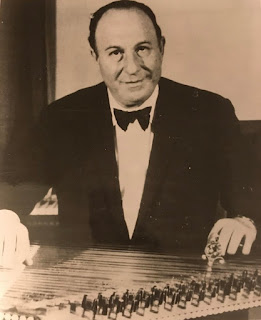
Fred Elias, 1961. NRE New Box 38, MZ. Star News and Pictorial.
|
If you are of a certain age or generation and you grew up near or in Worcester, Massachusetts, the Boston Metropolitan area, or Manchester, New Hampshire, you’ve likely heard the name Freddy Elias, Freddie Elias, Fred Elias, or Frederick Elias. Patrons of El Morocco, Club Zahra, or the Averof will recall various iterations of Elias’s musical ensemble playing at one of these memorable social venues for mixed Arab American, Armenian American, or American Greek crowds. The career of Fred Elias encompasses the period from roughly World War II to the 2010s, but the story of this Arab American violin virtuoso begins back in the 1920s.
The career of Fred Elias is one of the most documented by scholars of so-called Middle-Eastern music that I have encountered. For years, Midwest Mahjar avoided a feature post about Elias for this reason. Moreover, because nearly all of his recordings appeared to have been released in the period dominated by 33 ⅓ and 45 rpm records, I presumed none of his records existed in the 78 rpm format. However, Midwest Mahjar owns one of the few 78 rpm discs released by Frederick Elias and His Ensemble and I felt compelled to make the two sides of this record publicly available.
Frederick George Elias was born Fuad Ibrahim Husson Elias to Abraham and Karemi Noufel Elias on 27 June 1922 in Manchester, New Hampshire. He was the fourth of five children and the first son born to this couple of immigrants who married in 1914 in Lowell, Massachusetts. Within a year of their marriage, Abraham and Karemi moved to Manchester, New Hampshire, where Abraham was a dry goods salesman.
Immigration to New Hampshire by families from Greater Syria began in the late 1880s and early 1890s, with smaller communities settling in Berlin, Taylor, and Keene, and larger populations making Manchester and Dover their homes. Manchester, New Hampshire had over 300 Syrian/Lebanese residents in 1907. At least 1,000 Syrian/Lebanese people lived in the entire state at the same time. Not until the 1930s, did Syrian/Lebanese immigrants in Manchester begin to build community institutions and there was no Maronite or Melkite congregation in the entire state until 1948 and 1955. An excellent source for researchers interested in Syrian/Lebanese residents of Manchester, New Hampshire is Thaddeus M. Piertroski's The Lebanese Community of Manchester, N.H.
Growing up, Fred attended Henry Wilson Elementary and Central High schools. When he was seven, his father purchased a violin that Fred still owned on his 86th birthday. At Central, his music teacher, like Fred’s parents, was an immigrant, but George Gerassi, was born in the Kingdom of Serbia before it became Yugoslavia. Gerassi taught Elias to play violin, and in many ways the rest is history. After graduation, Fred worked in the factory of J.F. McElwain Shoe Company, a shoe manufacturer established in Manchester the same year Fred was born. Fred Elias enlisted in the United States army in 1942, and for a short time played first-chair violin for the Glen Miller U.S.O. Band. He fought in Normandy and primarily served as a tank gunner for most of his time in Europe. After World War II, Elias struggled with shrapnel that remained in his body. He was awarded a Purple Heart for his war wounds and lived with Post Traumatic Stress Disorder.
 |
| Note Fred's WWII Draft Card lists his birth year as 1927. Courtesy of Ancestry.com |
The Boston Conservatory of Music became Fred’s home after his discharge from the military and here he earned a degree and the credentials to be a music teacher specializing in the violin. Sources vary on whether Elias earned a bachelor's degree or a bachelors and masters degree.
In 1947, Fred married Ann Katsikas, the daughter of Greek immigrants, who themselves, settled and lived most of the remainder of their lives in Manchester, New Hampshire. Katsikas skated for the Ice Capades, a company that employed Fred Elias for a time. By 1950, the couple lived in a flat at 103 Hemenway in Boston and their first child, Alan, was born in 1948. Degree in hand, Fred secured work as an elementary school music teacher in Concord, New Hampshire, for the fall of 1950.
During this same time, under the name Frederick Elias, Metric Records released #7054 & #7055 “Sihr Il Fouad” (Enchantment) backed by "Raks Il Ahram" (Dance of the Pyramids). We do not know for certain who made up the orchestra that backs Elias on these two singles.

 |
| "Dance of the Pyramids" and "Enchantment" on 78 rpm. Courtesy of Richard M. Breaux collection. "Dance of the Pyramids" - https://youtu.be/DLs9jur-EAE "Enchantment" - https://youtu.be/kSeRg8SF89g |
The 1950s marked a transition period where supper clubs expanded on the hafla and mahrajan circuit’s venues. According to dancer and researcher Amy Smith, in and around Boston, there was Club Zahra (1952-1960), Club Khiam (1952-1972), and El Morocco (1955-1960). In an attempt to compete with these clubs, the Lawrence Chapter of the Eastern Federation of the Syrian-Lebanese group began calling their annual celebration “Club Algiers.” On April 11, 1954, Fred Elias, Tony Abdelahad, and Buddy Kent performed “the most favored ballads of the year.” Our Lady of the Annunciation Church in Boston hosted their annual hafla with Tony Abdelahad on oud, Charles Kahla on derbecke, and Fred Elias on violin on February 6, 1955. That summer, Elias and derbecke player Tony Tawa backed Djamal Aslan at the Saint George’s Syrian Orthodox Church’s annual outing in Lowell, Massachusetts. Archbishop Samuel David, himself a singer and with a two volume album set, officiated the morning mass for this event.
The following year, Anton Abdelahad, Sadie Melad, and Fred Elias packed the Catholic Center Auditorium for the Arabic Radio Program of Lawrence in March, 1956. Some 500 people similarly filled the Knights of Columbus Hall in Hartford, Connecticut to see Tony Abdelahad, Odette Kaddo, Tony Tawa, and Fred Elias perform to benefit flood victims in Tripoli. When Odette Kaddo sang at a charity hafla on 15 April 1956 in Waterbury, Connecticut, Fred Elias accompanied her on violin and her brother Nassar Kaddo appeared on oud. A week later, oud player and vocalist Anton Abdelahad, Fred Elias, and Ron Kirby played the “Club Algiers” eighth annual scholarship benefit in Lawrence, Massachusetts. Summer gigs meant the Saint George Orthodox-Worcester mahrajan on June 24 collaborating with Tony Abdelahad and Ronnie Kirby. Fall-season hafla found Elias and musicians and dancers from Club Zara entertaining at the Saint Mary’s Orthodox Church celebration in Cambridge and accompanying Hanan, Emil Kasses, and Tony Tawa for a concert back at Saint George Syrian Orthodox Church in Worcester.
 |
| Fred Elias. 27 June 1964, Express & News. Courtesy of Newspapers.com |
Fred Elias closed out the 1950s with more of the same annual church festivals but a few gigs that were out of the ordinary. For instance, Sadie Melad, Emil Kasses, and Elias travelled to Saint Ann’s hafla in New Jersey and the Syrian Orthodox Youth Organization Conference in Worcester, both in May, 1957. The conference performance featured Eddie Kochak, Hanan, Joe Budway, and Tony Tawa. The Saint Mary’s Orthodox Church of Pawtucket hafla in 1958 featured Fred with a lineup of musicians from Boston’s Club Morocco.
While appearances at the Our Lady of Annunciation Church hafla in April 1960 and similar events became a mainstay, Fred Elias’s career expanded to include more supper clubs and recording LP albums. Those Elias partnered up with included Najeeba Morad, Hanan, Joe Budway, and Mike Hamway. In 1960, Cameo Records featured Fred Elias on the album Soul of the East by Bubby Sarkassian & His Mecca Four. Magic Fingers Play Cleopatra’s Favorites and Hellenic Near East Gems followed as additional releases. Touring with Sarkassian and Manny Petro translated into trips north into Canada and appearances at Port Said in Montreal, Canada, in February and March 1962, as far west as Las Vegas, and as far south as San Antonio, Texas. During what appears to have been his first Texas shows, he joined Eddie Kochak and Emil Kasses at a festival hosted by San Antonio’s Lebanese American community at the Vallita Assembly Hall. This event resulted in a collaboration with Eddie Kochak and Hakki Obadia on Ya Salaam The New Amer-Abic Sound of the Middle East. Elias returned to San Antonio in September 1967 with George and Nick Kokoras, Ronnie Kirby, Emil Kasses, and Olga “Kahraman” Agby. The Kokoras brothers, along with oudist Richard Bayrouti, derbecke player/percussionist Arthur Chingris, and John Haddad on riqq, now began to make up the core of Fred Elias’s ensemble.


Belly Dancers albums and the Artistic Moods For Dance series represented a significant portion of Fred Elias’s 1970s and 1980s vinyl output. A new Boston supper/nightclub, owned by John and Ray Bandar, helped solidify his place in the lives and memories of a new generation of Middle East/Mediterranean American dancers and musicians. Working with Udi Joseph Kouyoumjian, Fred Elias via Federated Records released Beautiful Bellydance: Music for Listening and Dancing in 1975. In the same year, Artistic Moods For Dance with the Fred Elias Ensemble and John Tatassopoulos hit record shelves. Basically, the same core leads and ensemble dropped Artistic Moods For Dance volumes II & III. Additional albums, all separate projects included Big Mamoog with Eddie Mekjian, Mystical Temptations with John Tatassopoulos, and Vina with Florence Haddad. Many of the musicians of Arab, Armenian, or Greek descent, who teamed up with the Freddie Elias Ensemble, proved to be essential to the success of The Averof. Opened in 1972, Fred Elias, George Abdo, the Kokoras Brothers, Ernie Kamanis, Joseph Kouyoumjian, and Harry Bedrosian all headlined on various nights from the late 1970s through the mid-1990s. Elias even appeared on a postcard sold regularly at The Averof in the 1980s.
 |
| Fred Elias in the tan suit. Postcard from The Averof. Courtesy of Richard M. Breaux collection. |
Even after The Averof burned down, the Fred Elias Ensemble continued to publicly perform at anniversaries, birthday celebrations, and places like The Lafayette Club, Karoun, and the Athenian Corner. Youtube video slows Fred still playing violin at his 91st birthday party in 2013. His ensemble still booked gigs as recently as 2017. Many of the musicians Fred played with in his youth were retired or had passed on, but others like Joseph Kouyoumjian, the Kokoras Brothers, and Arthur Chingris continued to perform with Fred. On January 13, 2018, Fred Elias passed away leaving his wife of over 70 years and two adult children. Thanks to the work of Amy Smith at Flaming Cheese Productions, Benita Oteri, Artemis Mourat, and others at The Gilded Serpent: The Journal of Record for Middle Eastern Music, Dance, and Belly Dance, the life of Fred Elias, and many other musicians and dancers of the vinyl/post-shellac music era, are available online.
Richard M. Breaux
© Midwest Mahjar




Comments
Post a Comment